Search the site...

OPTIMISTIC DISCONTENT
  • Home
  • Curriculum
    • Curriculum Framework
    • Unit Design >
      • Standards >
        • National Visual Arts Standards
        • New! Missouri Visual Arts Learning Standards
      • Unit & Priority Standards
      • Enduring Understandings
      • Unit Themes
      • Essential Questions >
        • EQ Examples: Overarching
        • EQ Examples: Topical
    • Assessment Design >
      • Scoring Guides
      • Proficiency Scales
    • Lesson Design >
      • Inquiry-based Lesson Design
      • Teaching through Inquiry in Art
      • Inquiry-based Lesson Structure
    • Unit Examples >
      • Elementary Units
      • Middle School Units
      • High School Units
    • Resources
  • Presentations
    • Speaker Request Form
  • About
    • Thought Blog
    • More about Michelle
  • Contact
  • Community
  • Home
  • Curriculum
    • Curriculum Framework
    • Unit Design >
      • Standards >
        • National Visual Arts Standards
        • New! Missouri Visual Arts Learning Standards
      • Unit & Priority Standards
      • Enduring Understandings
      • Unit Themes
      • Essential Questions >
        • EQ Examples: Overarching
        • EQ Examples: Topical
    • Assessment Design >
      • Scoring Guides
      • Proficiency Scales
    • Lesson Design >
      • Inquiry-based Lesson Design
      • Teaching through Inquiry in Art
      • Inquiry-based Lesson Structure
    • Unit Examples >
      • Elementary Units
      • Middle School Units
      • High School Units
    • Resources
  • Presentations
    • Speaker Request Form
  • About
    • Thought Blog
    • More about Michelle
  • Contact
  • Community

YardSticks

5
6
7
8
9
10
11

Picture

Age 11 Takeaways

Incoming 6th graders are typically eleven years old, each progressing through a range of characteristics that should be considered. When thinking about 6th grade lessons, keep in mind the typical abilities and characteristics of not only eleven year olds, but how those needs change as they transition to twelve.
Favorite Themes for children this age:
  • ​Our country  and the world
  • Long ago and far away
  • History of cultures
  • Racial and ethnic  diversity
  • Environmental concerns in the immediate environment (for example, air or water pollution)
  • Literary characters or a theme emerging from a particular book
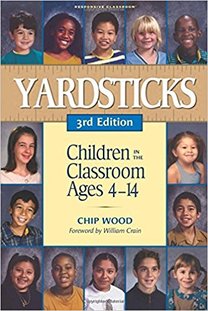
Yardsticks is a fantastic resource that offers age-by-age characteristics of typical child development. These general indicators are helpful to be aware of as you develop curriculum and help children grow. I have included characteristics that I find helpful when thinking specifically about art curriculum, but there is much more included for each age. I highly recommend reading the entire book.​

Drawing on decades of educational experience and a wealth of research, Yardsticks invites every adult who teaches or cares for children to celebrate the incredible developmental journey that occurs from ages four through fourteen. Combining easy-to-access information about the cognitive, social-emotional, and physical characteristics unique to each age with practical advice for how to apply this knowledge, Yardsticks offers parents and educators a foundation for helping children grow and thrive.
Cognitive Growth:
Eleven Year-Olds Growth Patterns -
  • Would rather learn new skills than review or improve previous work
  • Becoming more adept at abstract thinking - for example, they can understand ideas such as "justice"
  • With improving reasoning skills, they can establish and modify rules and develop hypotheses
  •  Increasingly able to see the world from various perspectives
In the Classroom - 
  • Developing new abilities in deductive reasoning, making this a good age for scientific study, mathematical problem solving, invention, and debate, but hands-on learning is still critical for most
  • Learn well in collaborative groups
  • Self-absorbed and interested in imagining themselves in adult roles; this makes history, biography, and current events exciting
  • Like "adult" academic tasks such as researching, interviewing, footnoting, and creating a bibliography
  • Enjoy board games, intellectual puzzles, brain teasers, and even tests
  • Usually challenged rather than defeated by reasonably hard work; need help with time-management and homework skills
  • May show interest in and facility for languages, music, or mechanics; need time to explore these areas
  • Interested in learning about older and very young people
Fine Motor Ability:
In the Classroom - 
  • Highly improved fine motor skills lead to more confidence in exploring delicate work (for example, calligraphy, linoleum block printing, and Japanese brush painting); art is an important vehicle to greater focus in reading and math
  • Often enjoy handwork (weaving, braiding, sewing, etc.) which may aid concentration and serve as an outlet for stress

Proudly powered by Weebly