Search the site...

OPTIMISTIC DISCONTENT
  • Home
  • Curriculum
    • Curriculum Framework
    • Unit Design >
      • Standards >
        • National Visual Arts Standards
        • New! Missouri Visual Arts Learning Standards
      • Unit & Priority Standards
      • Enduring Understandings
      • Unit Themes
      • Essential Questions >
        • EQ Examples: Overarching
        • EQ Examples: Topical
    • Assessment Design >
      • Scoring Guides
      • Proficiency Scales
    • Lesson Design >
      • Inquiry-based Lesson Design
      • Teaching through Inquiry in Art
      • Inquiry-based Lesson Structure
    • Unit Examples >
      • Elementary Units
      • Middle School Units
      • High School Units
    • Resources
  • Presentations
    • Speaker Request Form
  • About
    • Thought Blog
    • More about Michelle
  • Contact
  • Community
  • Home
  • Curriculum
    • Curriculum Framework
    • Unit Design >
      • Standards >
        • National Visual Arts Standards
        • New! Missouri Visual Arts Learning Standards
      • Unit & Priority Standards
      • Enduring Understandings
      • Unit Themes
      • Essential Questions >
        • EQ Examples: Overarching
        • EQ Examples: Topical
    • Assessment Design >
      • Scoring Guides
      • Proficiency Scales
    • Lesson Design >
      • Inquiry-based Lesson Design
      • Teaching through Inquiry in Art
      • Inquiry-based Lesson Structure
    • Unit Examples >
      • Elementary Units
      • Middle School Units
      • High School Units
    • Resources
  • Presentations
    • Speaker Request Form
  • About
    • Thought Blog
    • More about Michelle
  • Contact
  • Community

YardSticks

5
6
7
8
9
10
11

Picture

Age 6 Takeaways

Incoming 1st graders are typically six years old, each progressing through a range of characteristics that should be considered. When thinking about 1st grade lessons, keep in mind the typical abilities and characteristics of not only six year olds, but how those needs change as they transition to seven.
Favorite Themes for children this age:
  • ​Families
  • Friends
  • Our School
  • Workers in our school
  • Jobs people do in our community
  • Nature topics (such as butterflies, seasons, plants)
  • Cultural, racial, language, and other differences among people
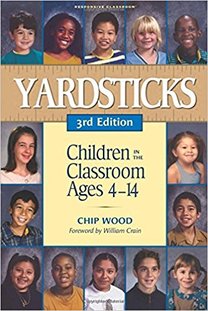
 Yardsticks is a fantastic resource that offers age-by-age characteristics of typical child development. These general indicators are helpful to be aware of as you develop curriculum and help children grow. I have included characteristics that I find helpful when thinking specifically about art curriculum, but there is much more included for each age. I highly recommend reading the entire book.

Drawing on decades of educational experience and a wealth of research, Yardsticks invites every adult who teaches or cares for children to celebrate the incredible developmental journey that occurs from ages four through fourteen. Combining easy-to-access information about the cognitive, social-emotional, and physical characteristics unique to each age with practical advice for how to apply this knowledge, Yardsticks offers parents and educators a foundation for helping children grow and thrive.
Cognitive Growth:
Six Year-Olds Growth Patterns -
  • Learn best through discovery; love asking questions and trying out new games and ideas
  • Better understand spatial and functional relationships
  • Very ambitious and motivated to learn; may choose projects that are too hard
  • Enjoy the process more than the product
  • Love to color and paint
  • Engage in more elaborate cooperative and dramatic play than at five
  • Increasingly interested in computers
  • beginning to understand past and present and how and why things happen
  • Beginning to be interested in skill and technique for their own sake
  • Like to "work"; enjoy reading and writing 
In the Classroom - 
  • Experience an artistic explosion; children seriously experiment with clay, paints, dancing, coloring, book making, weaving, and singing; need to feel that their attempts are valued; that there is no right and wrong way to approach art; risk-taking now enhances later artistic expression and competence
  • Proudly produce a great quantity of work but are unconcerned with quality; whatever the activity - whether academics, clean up, or snack - their delight lies in the doing (especially when doing for themselves)
  • Need social studies content connected to here and now; find history difficult unless it is closely associated with the present
  • Enjoy and learn much from field trips followed by representational activities such as telling about the trips or using blocks to show what they saw.
Proudly powered by Weebly